
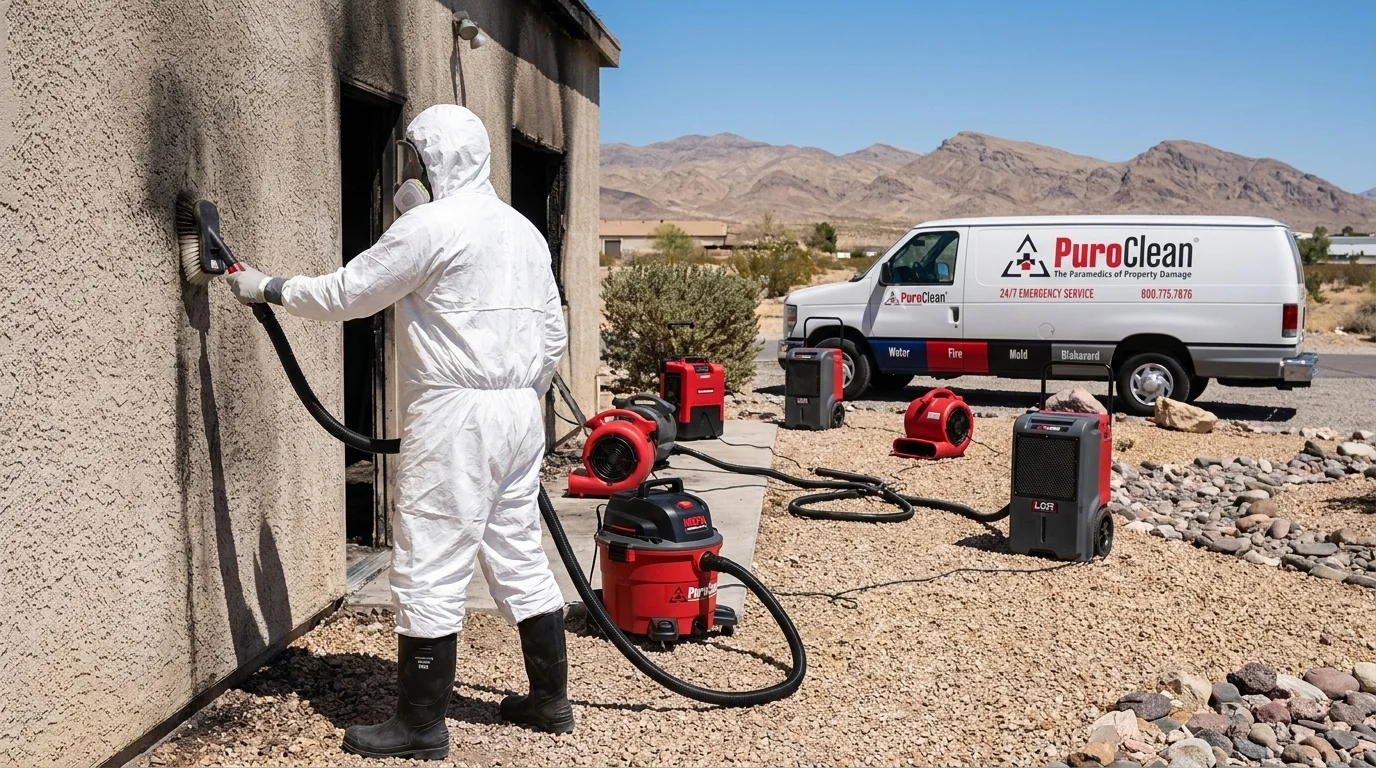
Emergency Commercial Fire Restoration in Las Vegas
Emergency commercial fire restoration in Las Vegas and surrounding areas. Insurance billing accepted. Call +17025513040.
Fire damage emergency in Las Vegas? Call now for emergency service. Our crew responds fast to secure the property and start the recovery.
Smoke doesn’t stop at the fire line. After a commercial fire, soot migrates through HVAC systems, settles into ceiling tiles three rooms away from the burn, and embeds in upholstery and inventory that never saw a flame. The visible char is the easy part, it’s the invisible residue, the corrosive off-gases still reacting with metal surfaces, and the odor locked inside wall cavities that determine whether a business reopens in weeks or months. Commercial fire restoration is the disciplined process of stopping that secondary damage before it compounds.
What commercial fire restoration actually involves
Fire leaves behind at least three distinct damage streams that have to be worked simultaneously: structural damage from heat and flame, smoke and soot contamination across the entire building envelope, and water damage from suppression efforts. On a commercial property, each of those streams is larger in scale, more square footage, more HVAC distribution, more contents, more stakeholders, than a typical residential loss.
Soot itself isn’t uniform. Protein soot from cooking fires is nearly invisible but extraordinarily pungent and greasy, bonding tightly to painted surfaces. Synthetic soot from burning plastics, wiring, or composite materials is dry, powdery, and deeply alkaline, it begins etching chrome fixtures, aluminum window frames, and electronics within hours of deposition. Wood-based soot falls somewhere between the two. Identifying which type of soot (or which combination) is present determines which cleaning chemistry and which application method will work, and which will make the damage worse.
On the structural side, heat warps steel, delaminates drywall, and compromises the adhesive bonds in engineered lumber. Water from sprinkler systems and fire hoses saturates insulation and subfloor assemblies that may not show visible damage at all. A thorough commercial fire restoration scope addresses all three streams, not just the rooms that burned.
Our process
-
Emergency stabilization and safety assessment. Before any cleaning begins, the structure is evaluated for load-bearing integrity, active electrical hazards, and air quality. Utilities are coordinated with the relevant authorities. Board-up and tarping protect the building from weather intrusion and unauthorized entry while the full scope is developed.
-
Soot characterization and damage mapping. Technicians identify soot type in each affected zone, document pre-existing conditions, and photograph all damaged materials and contents. This documentation drives both the cleaning protocol and the insurance claim, adjusters need a room-by-room damage matrix, not a general description.
-
Contents pack-out and inventory. Salvageable contents, furniture, equipment, inventory, documents, are catalogued, packed, and transported to a controlled facility for cleaning and storage. This clears the workspace for structural restoration and protects business assets from ongoing soot and odor exposure during the rebuild.
-
Structural cleaning, deodorization, and HVAC remediation. Affected surfaces are cleaned using chemistry matched to the soot type: alkaline cleaners for protein residues, dry-sponge methods for loose synthetic soot before wet cleaning, solvent-based agents for heavy tar deposits. Ductwork is cleaned and sealed to prevent re-contamination. Thermal fogging and hydroxyl or ozone treatment address odor molecules embedded in porous materials, drywall, insulation, wood framing, that surface cleaning cannot reach.
-
Moisture remediation and reconstruction coordination. Suppression water is extracted, affected assemblies are dried to IICRC S500 standards, and moisture readings are documented before any rebuild begins. Reconstruction, framing, drywall, finishes, flooring, follows once the structure is confirmed dry and clean, with a written scope provided before work starts.
What separates a good fire restoration response from a bad one
The most common failure in commercial fire restoration is treating it as a cleaning job rather than a chemical and structural problem. Wiping soot with the wrong agent, using a wet cloth on dry synthetic soot, for example, drives particles deeper into the substrate and can spread alkaline residue across surfaces that were previously unaffected. Once that happens, the damage footprint grows.
A second frequent gap is ignoring the HVAC system. In a commercial building, the air handler distributes smoke residue to every zone it serves during and after the fire. Restoration that cleans the burn room but leaves contaminated ductwork will result in odor callbacks and potential air quality complaints from occupants, and a reopened insurance claim.
Insurance adjusters on commercial losses look for documented moisture readings before and after drying, a line-item contents inventory with condition notes, and a clear separation between fire damage and pre-existing conditions. Gaps in that documentation are the most common reason supplements get denied.
What does commercial fire restoration cost?
Typical costs for commercial fire restoration vary widely based on building size, soot type, suppression water volume, and the extent of contents involvement. Most commercial losses fall somewhere in the ranges below, these are industry-typical figures, not quotes.
| Scenario | Typical range |
|---|---|
| Single office or retail room, limited soot | $8,000 – $20,000 |
| Multi-room commercial suite, mixed soot types | $20,000 – $60,000 |
| Full floor or large open-plan space | $60,000 – $150,000 |
| Contents pack-out and off-site cleaning | $5,000 – $30,000 |
| HVAC cleaning and sealing (commercial system) | $3,000 – $15,000 |
| Full structural rebuild following major fire | $150,000 – $500,000+ |
Every loss is different, and PuroClean of East Las Vegas provides a written scope of work before any restoration begins. Commercial property insurance typically covers fire and smoke damage to the structure and contents, as well as business interruption, your policy’s specific sublimits and deductibles will determine your out-of-pocket exposure.
Seasonal and regional considerations
Las Vegas’s dry desert climate affects fire restoration in ways that aren’t obvious. Low ambient humidity means soot particles stay airborne longer and travel farther through a building before settling, contamination zones in desert-climate fires tend to be larger relative to the burn area than in humid regions. The same dry air that accelerates soot migration also means suppression water evaporates faster at the surface, which can mask deeper moisture in concrete slabs and CMU block walls common in commercial construction throughout the valley. Thermal imaging and deep-probe moisture readings are essential here, surface readings alone underestimate the drying load.
Summer temperatures in the Las Vegas valley also mean that any building left without climate control after a fire will see rapid secondary microbial growth in suppression-water-affected materials, compressing the timeline for extraction and drying.
Service area
PuroClean of East Las Vegas serves commercial properties throughout Las Vegas, Henderson, North Las Vegas, Summerlin, and surrounding communities in Clark County. City-specific service pages cover individual markets, this page describes the full scope of what commercial fire restoration involves regardless of location.
If your building has smoke in the ductwork, soot on surfaces you haven’t reached yet, or a smell that didn’t exist before the fire, the secondary damage is still progressing. Call PuroClean of East Las Vegas at +17025513040 to begin smoke and soot removal and get a written scope before the restoration window narrows further.
Frequently Asked Questions
What's the difference between protein soot and synthetic soot, and why does cleanup vary so much?
How long does commercial fire restoration typically take before a business can reopen?
Does commercial property insurance cover fire and smoke restoration?
Why does the HVAC system need to be cleaned after a commercial fire, even in areas that didn't burn?
What should a business owner do in the first few hours after a commercial fire while waiting for restoration crews?
Looking for the best commercial fire restoration company in Las Vegas?
PuroClean of East Las Vegas provides commercial fire restoration in Las Vegas, NV and the surrounding area. Customers rate us 4.9 out of 5 stars across 21 Google reviews. We answer calls 24/7 — call +17025513040 for immediate help.
Need Commercial Fire Restoration now?
We respond 24/7 across Las Vegas and surrounding NV cities.
Related Coverage
- Our Restoration Services
- Contact PuroClean of East Las Vegas
- Emergency Commercial Fire Restoration in Boulder City
- Emergency Commercial Fire Restoration in Henderson
- Emergency Commercial Fire Restoration in North Las Vegas
- Emergency Commercial Fire Restoration in Paradise
- Emergency Commercial Fire Restoration in Spring Valley
- Emergency Commercial Fire Restoration in Sunrise Manor
- Emergency Commercial Fire Restoration in Whitney