
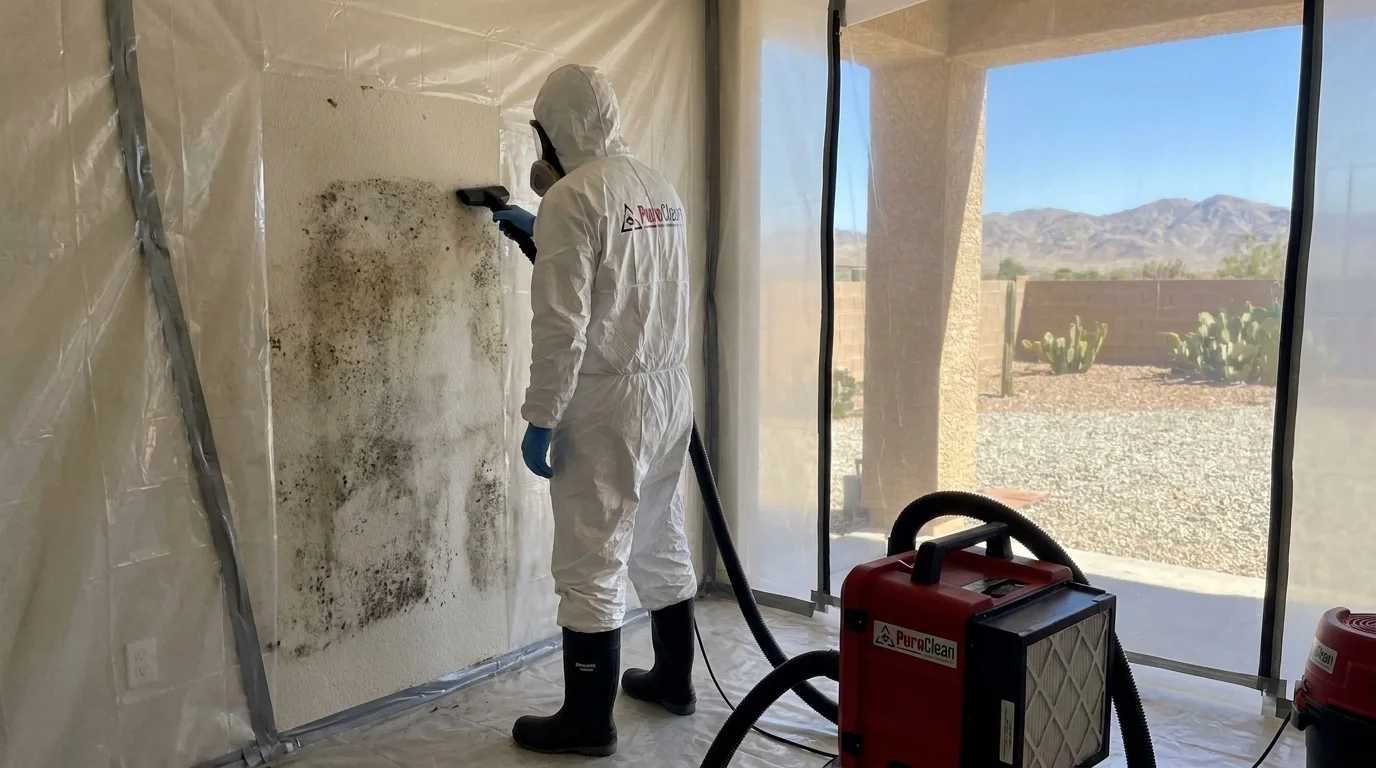
Mold Remediation in Las Vegas
Mold remediation in Las Vegas and surrounding areas. Insurance billing accepted. Call +17025513040.
What mold remediation actually involves
You noticed the smell first, that damp, earthy odor behind the bathroom vanity or in the corner of the garage that wouldn’t go away after you cleaned. Then you saw the discoloration: dark patches spreading along drywall, fuzzy growth creeping under baseboards, or a greenish-black bloom on ceiling tiles above a slow drip you thought you’d fixed months ago. Mold can colonize a wet surface in as little as 24 to 48 hours, and by the time it’s visible, the colony is well established. Mold removal isn’t wiping a surface with bleach, that approach kills surface cells while leaving the root structure (hyphae) intact and the spore count in the air unchanged.
Professional mold abatement starts with understanding what you’re dealing with: the species present, the extent of colonization behind visible surfaces, and the moisture source still feeding growth. Without addressing that source, any remediation is temporary. The work itself involves physical containment of affected zones, negative air pressure to prevent cross-contamination, HEPA-filtered air scrubbing, controlled removal of colonized materials, and post-remediation verification through air sampling, not a visual check, but actual spore counts compared against an outdoor baseline.
In Las Vegas, the dry climate creates a false sense of security. Homes here still develop mold, it just tends to concentrate in specific, predictable locations: under slab leaks that go undetected for weeks, inside poorly ventilated attic spaces where monsoon-season humidity gets trapped, behind shower walls with failing grout, and around evaporative cooler pads and ductwork where condensation accumulates. Stucco exteriors common to the valley can also wick moisture inward after heavy rain events, feeding wall cavity growth that stays invisible until drywall is opened.
Our process
-
Moisture mapping and scope assessment. Before any material is touched, we identify every wet or elevated-humidity zone using moisture meters and thermal imaging. This tells us where mold is actively growing versus where it has already dried, both matter for remediation scope. We also document the likely moisture intrusion source so it can be corrected before or during remediation.
-
Containment setup. Affected areas are isolated with 6-mil polyethylene sheeting and negative air pressure machines exhausted to the exterior. This prevents disturbed spores from migrating to clean areas of the structure during demolition and cleaning. For larger infestations or HVAC-connected zones, containment barriers are extended to cover return air pathways.
-
Controlled demolition and mold abatement. Colonized porous materials, drywall, insulation, wood framing with surface growth, are removed, double-bagged in poly, and disposed of per local waste guidelines. Non-porous surfaces with surface mold are HEPA-vacuumed, then cleaned with EPA-registered antimicrobial agents. Wire brushing or sanding of structural wood may be required for deeper penetration, always under continued negative air pressure.
-
HEPA air scrubbing and drying. Commercial HEPA air scrubbers run continuously throughout the project and for a defined period after demolition is complete. This pulls airborne spores through a multi-stage filtration system before they can resettle. If any residual moisture remains in structural components, drying equipment is deployed to bring materials to acceptable moisture content before encapsulation or reconstruction begins.
-
Post-remediation clearance testing. A successful mold cleanup isn’t declared by the crew that did the work, it’s verified by air sampling that compares indoor spore counts (by species and concentration) against an outdoor control sample taken the same day. Counts should be at or below outdoor levels with no dominant indoor species that weren’t present outside. We provide this documentation, which is also what most insurance carriers and real estate transactions require.
What separates a good mold remediation response from a bad one
The most common failure in mold cleanup is treating the symptom without finding the source. A crew that removes visible mold without confirming the moisture intrusion is fixed is setting up a callback in six months. Equally problematic is inadequate containment, opening walls in a moldy bathroom without negative air pressure can spike spore counts throughout the entire HVAC system within hours.
Less experienced operators often skip clearance testing, declaring the job complete after a visual inspection. Visually clean surfaces can still carry spore counts that exceed outdoor baseline levels, particularly after dry brushing or sanding without proper filtration. Insurance adjusters and industrial hygienists reviewing a claim will look for pre- and post-remediation air sampling data, a written scope of work tied to a moisture investigation, and evidence that affected materials were properly disposed of rather than dried in place.
Another area where corners get cut: HVAC systems. If mold is present near a return air duct or inside air handling equipment, spores have almost certainly been distributed through the duct system. Remediating the source room without inspecting and cleaning the ductwork leaves a reservoir of contamination that will recolonize treated surfaces.
Seasonal and regional considerations
Las Vegas sits in a desert, but the valley’s monsoon season, roughly July through September, brings humidity spikes that can catch homeowners off guard. Homes sealed tight against summer heat trap that moisture inside, and evaporative coolers running through humid monsoon days push damp air directly into living spaces. Attic spaces above flat or low-slope roofs common in valley construction can see condensation accumulate during these weeks, particularly where insulation is compressed or vapor barriers are absent. Post-monsoon is consistently when mold calls increase across the East Las Vegas area.
Slab leaks are another regional driver. The valley’s soil movement and aging copper pipe infrastructure mean slab leaks are common, and because they’re under concrete, they often go undetected for weeks or months, saturating subfloor materials and wall bases before any visible sign appears.
Service area
PuroClean of East Las Vegas serves the greater Las Vegas valley including Henderson, North Las Vegas, Summerlin, Green Valley, Boulder City, and surrounding communities. Dedicated service-area pages cover mold remediation in each of these neighborhoods, this page covers the process and standards that apply across all of them.
If you’re seeing visible growth, detecting a persistent musty odor, or you’ve had a water intrusion event in the past 30 days, the right next step is an air quality assessment, not a wait-and-see approach. Call PuroClean of East Las Vegas at (702) 551-3040 to schedule your mold inspection and air sampling.
Services We Handle
- Attic Mold Removal
- Basement Mold Removal
- Bathroom Mold Removal
- Black Mold Removal
- Crawl Space Mold Removal
- Emergency Mold Removal
- Mold Removal Behind Walls
Frequently Asked Questions
What's the difference between mold removal and mold remediation, and does it matter which one I ask for?
At what point does a mold problem require full containment versus a simpler surface cleaning?
What does post-remediation clearance testing actually measure, and who should conduct it?
My home had a water leak that was repaired weeks ago. Is mold still a concern if I don't see any growth yet?
Can mold inside ductwork spread to rooms that weren't originally affected?
Watch: Mold Remediation in Las Vegas
Looking for the best mold remediation company in Las Vegas?
PuroClean of East Las Vegas provides mold remediation in Las Vegas, NV and the surrounding area. Customers rate us 4.9 out of 5 stars across 21 Google reviews. We answer calls 24/7 — call +17025513040 for immediate help.
Need Mold Remediation now?
We respond 24/7 across Las Vegas and surrounding NV cities.
Related Coverage
- Our Restoration Services
- Contact PuroClean of East Las Vegas
- Mold Remediation in Boulder City
- Mold Remediation in Henderson
- Mold Remediation in North Las Vegas
- Mold Remediation in Paradise
- Mold Remediation in Spring Valley
- Mold Remediation in Sunrise Manor
- Mold Remediation in Whitney
- How To Choose a Restoration Company in Las Vegas (Without Getting Burned)
- How To Test for Mold in Your Home (DIY Kits vs a Pro Inspection)
- 7 Signs You Have Hidden Mold (and What To Do Next)