
Emergency Fire Damage Restoration in Las Vegas
Emergency fire damage restoration in Las Vegas and surrounding areas. Insurance billing accepted. Call +17025513040.
Fire damage emergency in Las Vegas? Call now for emergency service. Our crew responds fast to secure the property and start the recovery.
What fire damage restoration actually involves
The fire is out, but the damage is still spreading. Within hours of extinguishment, acidic soot begins etching metal fixtures, yellowing wall paint, and permanently staining grout. Smoke odor migrates into wall cavities, HVAC ductwork, and soft furnishings, often in rooms that never saw a flame. The water from suppression efforts soaks into subfloors and drywall, creating a secondary damage layer that can go unnoticed for days. Fire damage restoration is a race against chemistry as much as a cleanup job.
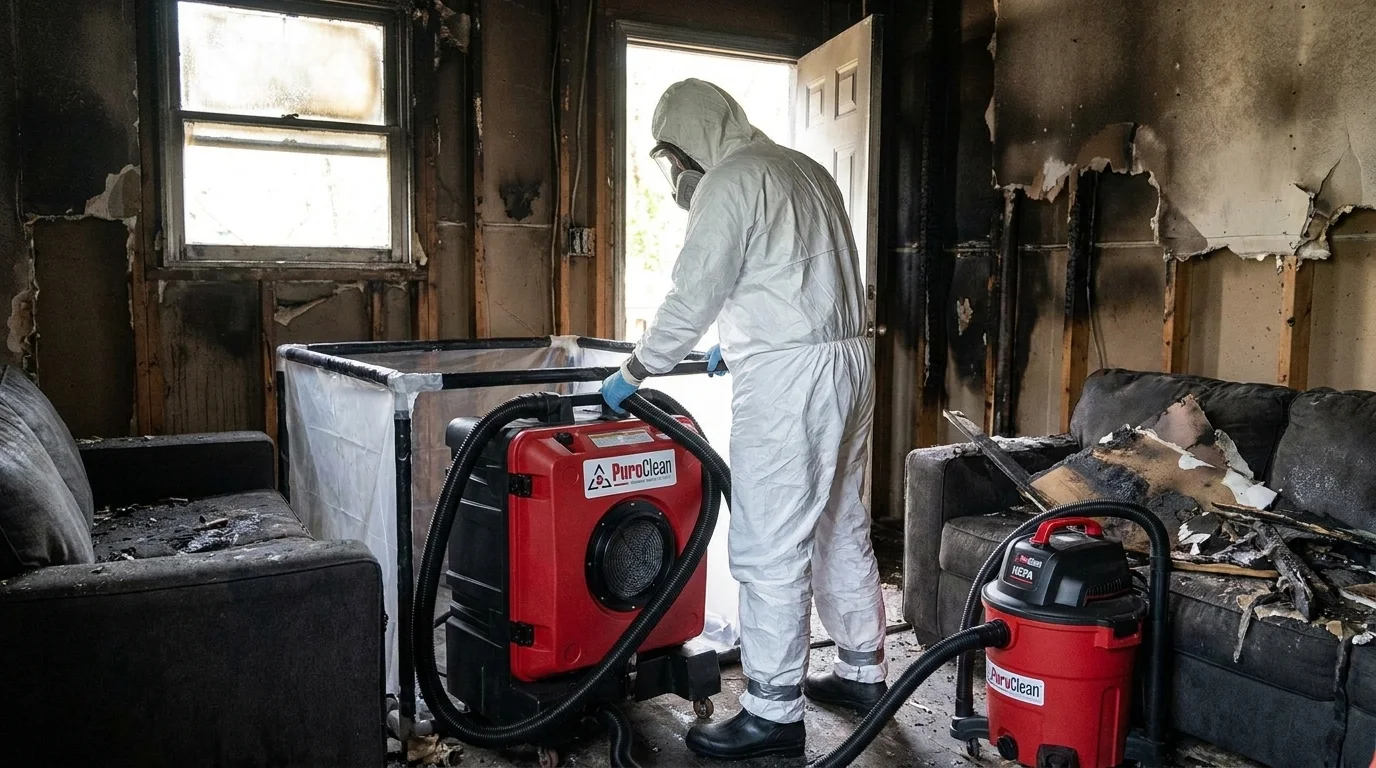
Restoring a fire-damaged home means working across multiple damage types simultaneously: char and structural compromise where the fire burned hottest, dry soot and smoke residue on every surface the thermal plume touched, and moisture intrusion from firefighting water. The work involves industrial air scrubbers with HEPA filtration to pull particulates out of the air, thermal foggers and ozone generators to neutralize smoke odor at the molecular level, ultrasonic cleaning equipment for salvageable contents, and controlled demolition of materials that cannot be restored. Timelines vary with fire size, a contained kitchen fire may be resolved in a week; a whole-floor structural fire can take four to six weeks before reconstruction begins.
Our process
1. Emergency stabilization and soot characterization Before any cleaning begins, the structure is assessed for safety, compromised load-bearing elements, broken glass, and active utility hazards. Simultaneously, the type of soot present is identified. Protein soot from kitchen fires is nearly invisible but leaves a powerful odor and a greasy film that bonds to surfaces differently than the dry, powdery soot from burning wood or the dense, sticky synthetic soot produced by burning plastics, foam, and carpet. Cleaning chemistry, tools, and sequence all change depending on what burned.
2. Contents pack-out and inventory Salvageable contents, furniture, clothing, electronics, documents, are inventoried, photographed, and removed to a controlled facility for cleaning before the structure is worked on. This protects items from secondary smoke exposure during restoration and gives insurance adjusters a documented record of every affected piece. Items that cannot be restored are catalogued separately for claim purposes.
3. Structural cleaning and dry soot removal Dry soot is vacuumed with HEPA equipment before any wet cleaning begins, wiping before vacuuming drives particles deeper into porous surfaces. Walls, ceilings, and structural framing are cleaned with dry chemical sponges and, where needed, alkaline cleaning agents that neutralize acidic soot residue. Ductwork is inspected and cleaned separately, because smoke circulating through an HVAC system will re-contaminate a cleaned structure every time the fan runs.
4. Odor neutralization, thermal fogging and ozone treatment Masking sprays cover smoke odor temporarily; neutralizing it requires penetrating the same spaces the smoke did. Thermal fogging disperses a deodorizing agent as a fine aerosol that follows smoke’s migration pathways into wall voids, carpet backing, and cabinet interiors. Ozone treatment, applied after occupants and pets are removed, oxidizes odor-causing compounds at the molecular level. Both methods are typically used in sequence for heavily affected structures.
5. Controlled demolition and handoff to reconstruction Materials that cannot be cleaned, charred framing, smoke-saturated insulation, heavily stained drywall, are removed and documented before reconstruction begins. This step is where scope disputes with insurance adjusters most often arise, and thorough photo documentation of every removed material is essential for a clean claim.
What separates a good fire damage response from a bad one
The most common mistake in post-fire cleanup is starting with wet cleaning before dry soot removal. Wet methods smear dry soot into porous surfaces, permanently setting stains that could have been vacuumed away. A second frequent error is skipping ductwork inspection, smoke travels through HVAC systems and deposits residue throughout, and a cleaned home will smell like smoke again within days if the ducts are ignored.
Insurance adjusters look for itemized documentation: photographs of every affected surface before cleaning, a written inventory of contents removed, and a clear line between what was cleaned versus what was demolished. Adjusters also scrutinize odor claims. Thermal fogging and ozone treatment logs, equipment used, duration, areas treated, provide the paper trail that supports odor-related line items on a claim.
A less obvious failure point is incomplete soot characterization. Synthetic soot from burning plastics contains compounds that require different cleaning chemistry than wood or paper soot. Using the wrong products leaves residue behind and can actually spread contamination. Experienced technicians test or visually identify soot type before selecting cleaning agents.
Seasonal and regional considerations
Las Vegas’s desert climate creates fire-specific patterns worth knowing. The valley’s low humidity, often below 15% in summer, means smoke residue dries and bonds to surfaces faster than in humid climates, compressing the window for effective dry soot removal. Monsoon season (July through September) brings the opposite problem: moisture from firefighting water or suppression systems has less chance to evaporate naturally, increasing the risk of mold colonization in smoke-damaged wall cavities if drying is delayed. Homes in the valley’s older neighborhoods, many built in the 1970s and 1980s, frequently have original ductwork that holds smoke residue in joints and flex-duct seams that newer construction avoids.
Service area
PuroClean of East Las Vegas handles fire and smoke restoration throughout the Las Vegas valley, including Henderson, North Las Vegas, Summerlin, Boulder City, and surrounding unincorporated Clark County communities. Dedicated service-area pages cover specific neighborhoods and cities, each one links back here for the full technical picture of what fire damage restoration involves.
If your home or property has been through a fire, the sooner soot removal begins, the more surface area and contents can be saved. Call PuroClean of East Las Vegas at +17025513040 to begin smoke and soot removal and get a documented scope of work started for your insurance claim.
Services We Handle
- Fire & Smoke Restoration
- Fire and Smoke Damage Cleanup
- Odor Removal
- Smoke Damage Restoration
- Smoke Odor Removal
- Soot Removal
Frequently Asked Questions
What is the difference between protein soot and synthetic soot, and why does it change how cleanup is done?
Why does smoke smell come back even after a professional cleaning?
What should I do — and not do — in the hours between the fire being extinguished and a restoration crew arriving?
How does fire damage restoration interact with a homeowner's insurance claim, and what documentation should I expect?
Can fire-damaged drywall and framing always be cleaned, or does some of it have to be removed?
Watch: Fire Damage Restoration in Las Vegas
Looking for the best fire damage restoration company in Las Vegas?
PuroClean of East Las Vegas provides fire damage restoration in Las Vegas, NV and the surrounding area. Customers rate us 4.9 out of 5 stars across 21 Google reviews. We answer calls 24/7 — call +17025513040 for immediate help.
Need Fire Damage Restoration now?
We respond 24/7 across Las Vegas and surrounding NV cities.
Related Coverage
- Our Restoration Services
- Contact PuroClean of East Las Vegas
- Emergency Fire Damage Restoration in Boulder City
- Emergency Fire Damage Restoration in Henderson
- Emergency Fire Damage Restoration in North Las Vegas
- Emergency Fire Damage Restoration in Paradise
- Emergency Fire Damage Restoration in Spring Valley
- Emergency Fire Damage Restoration in Sunrise Manor
- Emergency Fire Damage Restoration in Whitney
- How To Choose a Restoration Company in Las Vegas (Without Getting Burned)
- The Fire Damage Restoration Process, Explained
- How Professionals Remove Smoke Odor (and Why DIY Usually Fails)