
Commercial Restoration in Las Vegas
Commercial restoration in Las Vegas and surrounding areas. Insurance billing accepted. Call +17025513040.
A burst pipe behind a break room wall at 2 a.m. is a different problem than a flooded basement at home. In a commercial building, the same water event can shut down point-of-sale systems, compromise server rooms, trigger HVAC cross-contamination across multiple floors, and put you in violation of your lease’s damage-notification clause, all before the morning shift arrives. Commercial restoration is the discipline of stopping that cascade: stabilizing the structure, protecting business-critical assets, documenting the loss for your carrier, and getting your space back to code-compliant, occupiable condition with the least possible interruption to operations.
What Commercial Restoration actually involves
Commercial losses are rarely contained to one room or one category of damage. A kitchen suppression system discharge soaks drywall, saturates insulation, and leaves a chemical residue on food-contact surfaces, all at once. A fire in a retail suite pushes smoke through shared ductwork into neighboring tenants’ spaces. Water from a roof failure travels down interior walls and pools under raised flooring in ways that surface readings won’t catch.
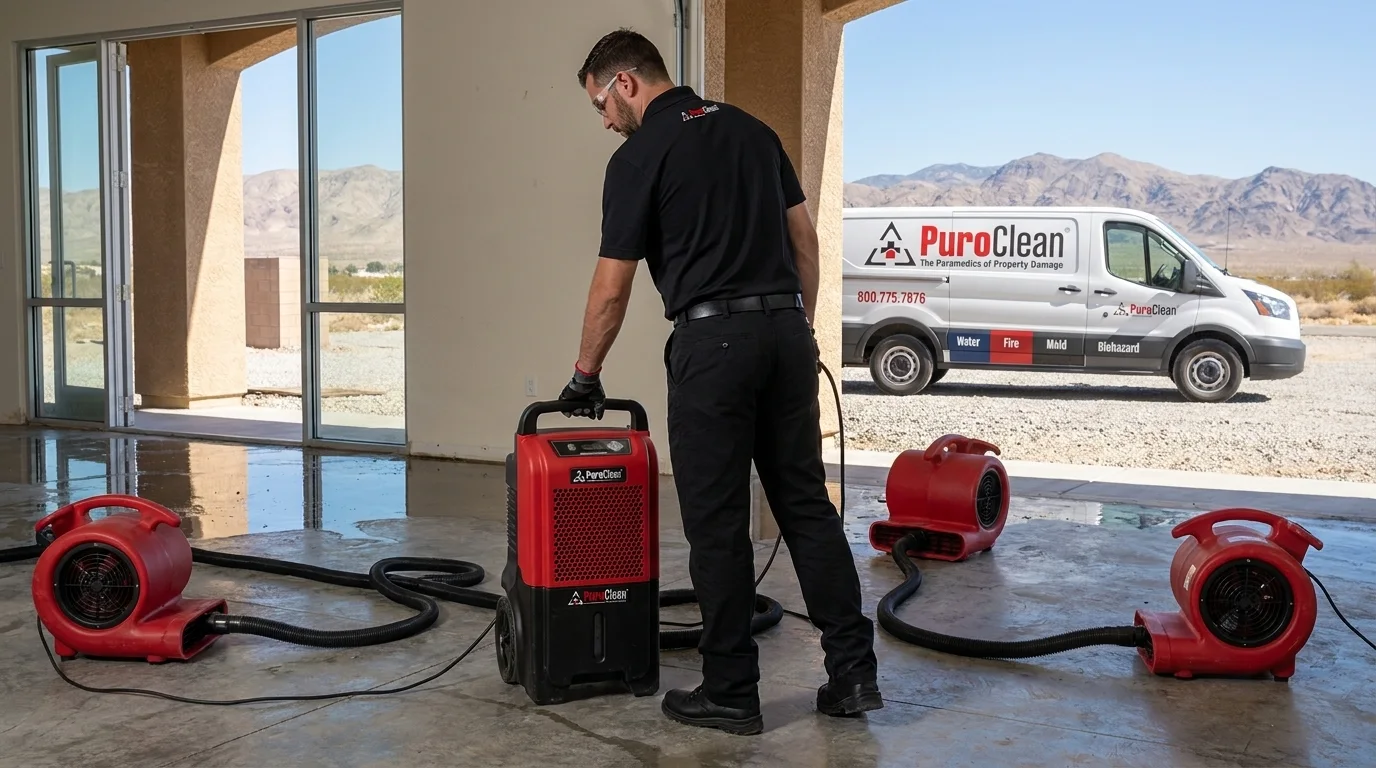
The work itself involves industrial-grade extraction and drying equipment scaled for large square footage: truck-mounted extractors, desiccant dehumidifiers rated for high-volume air throughput, and axial air movers positioned according to a drying plan, not just placed wherever they fit. Thermal imaging cameras identify moisture migration behind finished walls and under concrete slabs before that moisture becomes a mold problem. For fire and smoke events, soot characterization determines whether residue is dry and powdery (easier to HEPA-vacuum) or wet and oily (requires chemical sponging and odor neutralization). Contents, office equipment, inventory, fixtures, are documented, packed out if necessary, and tracked through a chain of custody.
Timeline depends heavily on loss category and building construction. Light commercial water damage in a single-tenant office suite with open-plan construction can reach drying goals in four to seven days. Multi-story losses, Category 3 contamination, or buildings with legacy construction (older Las Vegas commercial strips built with non-moisture-resistant drywall assemblies) routinely run longer and require more invasive demolition to reach saturated cavities.
Our process
-
Emergency stabilization and loss containment. The first priority is stopping ongoing damage, shutting off the water source, boarding openings after fire events, or isolating HVAC zones to prevent smoke or contaminated air from spreading. This step also includes placing plastic containment barriers to protect undamaged inventory, equipment, and adjacent tenant spaces.
-
Damage assessment and documentation. Every affected surface is mapped using moisture meters, thermal cameras, and visual inspection. For fire events, each room is categorized by soot type and odor severity. This documentation becomes the foundation of your insurance claim, scope, photographs, moisture readings, and material specifications that adjusters can review without ambiguity.
-
Extraction, demolition, and structural drying. Standing water is extracted first. Unsalvageable materials, saturated drywall, charred framing, contaminated insulation, are removed and disposed of per applicable waste-handling requirements. Drying equipment is deployed according to a psychrometric drying plan, with daily monitoring logs to confirm the structure is progressing toward established drying goals.
-
Cleaning, deodorization, and surface treatment. Depending on the loss type, this includes HEPA vacuuming and chemical sponging of soot, antimicrobial application to surfaces affected by Category 2 or 3 water, thermal fogging or hydroxyl generation for persistent odor, and cleaning of HVAC components if smoke or contaminated water entered the system.
-
Reconstruction and return to occupancy. Once the structure is dry and clean, rebuild begins, framing, insulation, drywall, flooring, painting, and finish work, scoped to match pre-loss condition. Work is permitted where required by Clark County or the City of Las Vegas, and final walkthroughs confirm the space is ready for your team and your customers.
What separates a good commercial restoration response from a bad one
The most common failure in commercial restoration is treating a large loss like a scaled-up residential job. Commercial buildings have different wall assemblies, different HVAC configurations, and different code requirements, and the drying standards that work in a 1,200-square-foot house do not automatically translate to a 10,000-square-foot retail space with drop ceilings and plenum air returns.
Experienced operators characterize soot before cleaning it. Dry soot wiped with a wet cloth becomes smeared and permanently embeds into porous surfaces. Protein residue from a kitchen fire is nearly invisible but produces a rancid odor that returns for months if treated only with surface cleaning. These distinctions matter to your adjuster too, a well-documented soot characterization report justifies the cleaning method and prevents disputes over scope.
Insurance adjusters on commercial losses also look closely at drying logs. Daily psychrometric readings that show moisture levels trending toward goal are evidence that the drying plan is working; flat or rising readings without a documented response are a red flag that can delay claim approval. A restoration contractor who cannot produce daily monitoring data is a liability in a commercial claim.
Finally, business-interruption implications make timeline documentation critical. If your policy includes business-interruption coverage, the restoration contractor’s records, start date, scope, daily progress, completion date, are what your broker uses to calculate the covered loss period.
What does Commercial Restoration cost?
Typical costs for commercial restoration vary significantly by loss type, building size, and damage category. The ranges below reflect industry-typical figures and are not quotes or estimates from PuroClean of East Las Vegas, every loss is different, and PuroClean of East Las Vegas provides a written scope of work before any work begins. Commercial property insurance typically covers sudden and accidental losses (burst pipes, fire, storm intrusion) subject to your policy’s deductible and coverage limits; gradual damage or deferred maintenance is commonly excluded.
| Scenario | Typical industry range |
|---|---|
| Small office suite, clean water (Cat 1), no demolition | $2,500 – $6,000 |
| Mid-size retail space, gray water (Cat 2), partial demo | $8,000 – $22,000 |
| Large commercial floor, black water (Cat 3), full remediation | $25,000 – $75,000+ |
| Commercial fire, single tenant suite, smoke and soot cleanup | $15,000 – $50,000 |
| Multi-tenant building, smoke migration through shared HVAC | $40,000 – $120,000+ |
| Full commercial reconstruction after major fire or flood | $80,000 – $300,000+ |
Seasonal and regional considerations
Las Vegas sits in the Mojave Desert, which creates restoration conditions that differ from most of the country. The low ambient humidity, often below 15% relative humidity in summer, accelerates structural drying timelines compared to coastal or humid-climate markets, which is an advantage. However, the valley’s monsoon season (typically July through September) brings short, intense rain events that commercial flat roofs and aging drainage systems are frequently not designed to handle. Ponding water on commercial rooftops, failed roof membrane seams, and overwhelmed interior drains are recurring causes of commercial water losses during monsoon season in the Las Vegas Valley. Buildings in older commercial corridors along East Las Vegas, many constructed in the 1970s and 1980s, often have original plumbing and roofing assemblies that are approaching or past their service life, making them disproportionately vulnerable during heavy rain events.
Service area
PuroClean of East Las Vegas serves commercial properties throughout the Las Vegas Valley, including Henderson, North Las Vegas, Summerlin, Boulder City, and the surrounding communities. The city-specific service pages for each area link back to this page for full service details. If your property is in the greater Clark County area and you are not sure whether we serve your location, call us directly at +17025513040.
If your commercial property has sustained water, fire, smoke, or storm damage, the next step is a documented damage assessment, not a ballpark number over the phone. Call PuroClean of East Las Vegas at +17025513040 to schedule your commercial loss assessment and get a written scope before work begins.
Frequently Asked Questions
Does my commercial property insurance cover restoration after a water or fire loss?
How do you minimize business interruption during a commercial restoration?
What is the difference between Category 1, 2, and 3 water damage, and why does it matter for a commercial building?
Why does smoke damage in a commercial building sometimes affect tenants who were nowhere near the fire?
What documentation should I preserve immediately after a commercial loss before the restoration crew arrives?
Looking for the best commercial restoration company in Las Vegas?
PuroClean of East Las Vegas provides commercial restoration in Las Vegas, NV and the surrounding area. Customers rate us 4.9 out of 5 stars across 21 Google reviews. We answer calls 24/7 — call +17025513040 for immediate help.
Need Commercial Restoration now?
We respond 24/7 across Las Vegas and surrounding NV cities.
Related Coverage
- Our Restoration Services
- Contact PuroClean of East Las Vegas
- Commercial Restoration in Boulder City
- Commercial Restoration in Henderson
- Commercial Restoration in North Las Vegas
- Commercial Restoration in Paradise
- Commercial Restoration in Spring Valley
- Commercial Restoration in Sunrise Manor
- Commercial Restoration in Whitney