
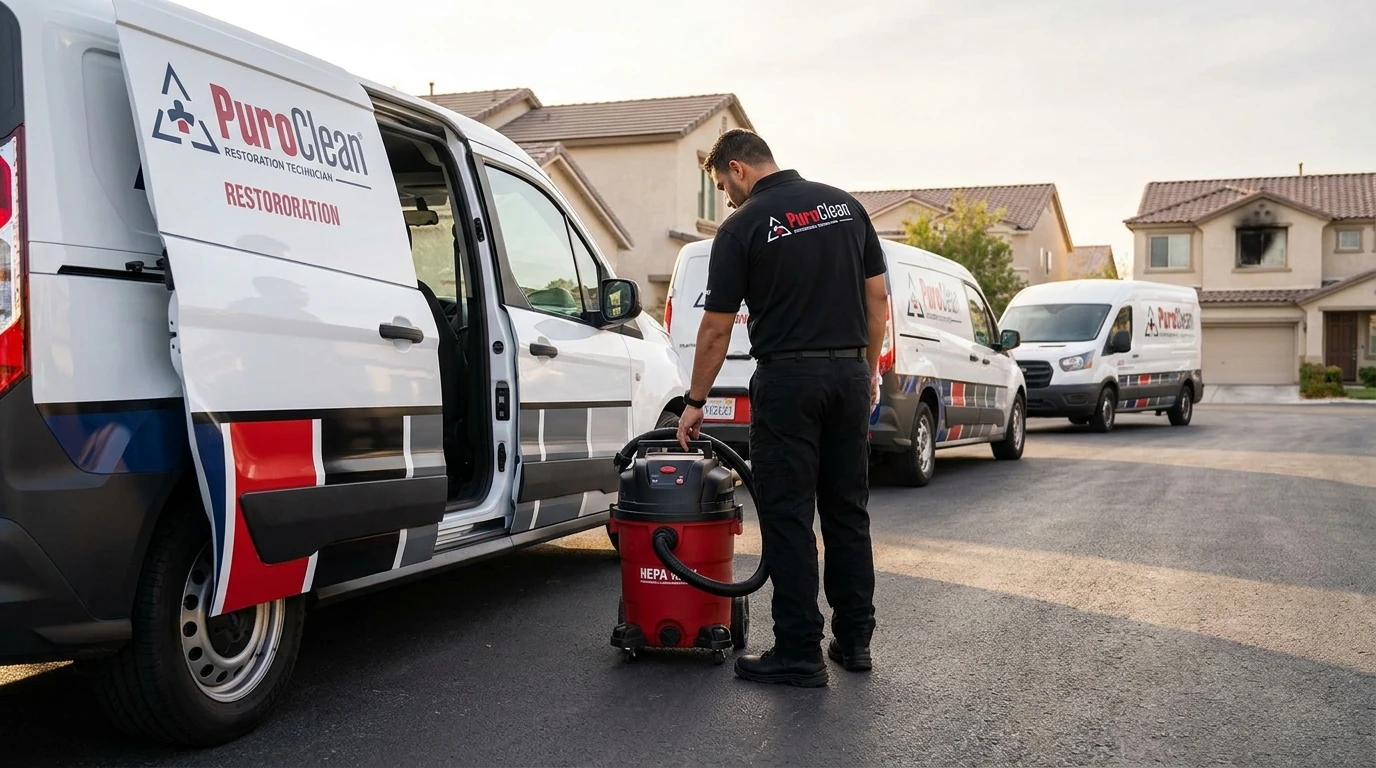
TL;DR: Fire damage restoration in Nevada typically costs between $3,000 and $75,000, with most residential losses falling in the $10,000 to $40,000 range. The final number depends on the size of the fire, how far smoke and soot traveled through the home, what materials were damaged, and whether structural repairs are needed. Every loss is different, and PuroClean of East Las Vegas provides a written scope before any work begins.
If you just had a fire in your Las Vegas home, even a small kitchen fire, you’re probably staring at a number on an insurance claim form and wondering whether it’s in the right ballpark. Smoke travels further than flames, soot embeds into drywall cavities and HVAC ducts, and the odor can make a home unlivable for weeks. This guide breaks down what restoration actually costs in Nevada, what moves that number up or down, and what your homeowners policy is likely to cover.
How Much Does Fire Damage Restoration Cost in Nevada?
In Nevada, fire damage restoration typically costs $3,000 to $75,000 for residential properties, with the average homeowner paying somewhere between $10,000 and $40,000 for a contained room fire with moderate smoke spread. Small, isolated fires (a stovetop flare-up caught quickly) can run $3,000 to $8,000 for soot cleaning and odor removal alone. A fire that burns through multiple rooms or reaches the attic can exceed $75,000 once structural repairs are included.
These are industry-typical ranges based on Nevada market conditions. Your actual cost depends on the specific factors below.
Typical Cost Ranges by Scenario
| Scenario | Typical Cost Range |
|---|---|
| Small kitchen fire, smoke contained to one room | $3,000 - $8,000 |
| Single-room fire, moderate smoke spread to adjacent rooms | $8,000 - $20,000 |
| Multi-room fire, significant soot and smoke throughout home | $20,000 - $50,000 |
| Large structural fire, partial roof or wall damage | $40,000 - $75,000 |
| Full structural loss with rebuild required | $75,000 - $200,000+ |
| Smoke and odor only (no visible flame damage) | $2,500 - $6,000 |
| Commercial fire restoration (office, retail, multi-family) | $15,000 - $150,000+ |
What Factors Drive the Cost Up or Down?
The size of the fire is only one variable. Several other factors have an equal or larger effect on the final restoration cost.
Smoke and soot spread. Smoke follows air currents through a home, often reaching rooms the fire never touched. Soot embeds into porous surfaces, drywall, insulation, wood framing, soft contents, and requires specialized cleaning methods. A fire contained to a kitchen can still require soot cleaning in every room if the HVAC system pulled smoke through the ductwork. The further smoke traveled, the higher the cost.
Structural damage. When fire burns through drywall, framing, flooring, or roofing, the restoration scope expands to include reconstruction. Charred framing must be assessed by a contractor; some can be cleaned and encapsulated, while compromised structural members must be replaced. Roof penetrations also create secondary water damage from firefighting efforts.
Water damage from suppression. Firefighting water causes its own damage. Saturated flooring, wet insulation, and soaked drywall must be extracted and dried to the IICRC S500 standard before reconstruction begins. If water damage is not addressed quickly, mold can follow within 24 to 72 hours. This is why fire restoration and water mitigation often happen simultaneously.
Contents and personal property. Furniture, electronics, clothing, and documents affected by smoke or soot may be restorable through professional contents cleaning and pack-out, or they may be total losses. Contents restoration is typically a separate line item on the insurance claim. PuroClean of East Las Vegas handles contents restoration and pack-out as part of a full fire restoration scope.
Odor removal. Smoke odor is one of the most persistent problems after a fire. Professional odor elimination uses thermal fogging, hydroxyl generators, and ozone treatment, not masking sprays. Severe odor cases, especially those involving synthetic materials or electrical fires, require multiple treatment cycles and can add $1,500 to $5,000 to the project cost.
Las Vegas-specific factors. Stucco and concrete block construction common in Summerlin and Centennial Hills neighborhoods can limit structural fire spread, but the porous interior finishes in older Downtown Las Vegas homes absorb soot and odor more aggressively. HVAC systems in Nevada homes run nearly year-round due to the climate, which increases the likelihood that smoke has circulated through every room.
What Does Homeowners Insurance Typically Cover?
Most standard homeowners insurance policies cover sudden, accidental fire damage, including the fire itself, smoke damage, and water damage from firefighting efforts. This is one of the most straightforward insurance claims in the restoration industry.
Here is what a typical Nevada homeowners policy covers for fire losses:
- Dwelling coverage (Coverage A): Structural repairs to the home, including framing, drywall, roofing, flooring, and built-in systems.
- Personal property coverage (Coverage C): Damaged or destroyed contents, subject to actual cash value or replacement cost value depending on your policy.
- Additional living expenses (Coverage D): Hotel, rental, and meal costs if the home is uninhabitable during restoration. Keep every receipt.
- Smoke and soot damage: Covered under the same dwelling claim as the fire itself, even in rooms the fire did not reach.
- Water damage from suppression: Covered as part of the fire loss, not as a separate water damage claim.
What is typically NOT covered: fires caused by arson by the policyholder, losses in vacant properties (check your policy’s vacancy clause), and certain business-use losses in a residential policy.
Deductibles and documentation. Your deductible applies before coverage kicks in. For a $25,000 fire claim with a $2,500 deductible, your insurer pays $22,500. The documentation that protects your claim includes a detailed written scope of work, photo evidence of all damage before any cleaning begins, a room-by-room inventory of affected contents, and moisture readings if water damage is present. PuroClean of East Las Vegas prepares this documentation as part of the restoration process and works directly with your adjuster.
For more on how insurance handles property damage claims, see the Nevada Division of Insurance for state-specific policyholder guidance.
What Does the Fire Damage Restoration Process Look Like?
Fire restoration is not a single service, it is a sequence of phases, each one setting up the next. Here is what a standard residential fire restoration looks like from first call to final walkthrough.
-
Emergency stabilization. The crew secures the property, boarding windows, tarping roof penetrations, and preventing unauthorized entry. This step protects the home from secondary damage while the scope is being assessed.
-
Damage assessment and scope writing. A project manager documents all fire, smoke, soot, and water damage room by room. This written scope is what the insurance adjuster reviews. Skipping this step or cleaning before documentation is one of the most common ways homeowners lose money on a claim.
-
Water extraction and drying. If firefighting water is present, extraction and structural drying begin immediately using commercial air movers and LGR dehumidifiers. Drying is monitored daily with calibrated moisture meters until readings meet the IICRC S500 drying standard.
-
Soot and smoke cleaning. Technicians clean all affected surfaces using dry sponges, chemical sponges, and HEPA vacuums before applying wet cleaning methods. Order matters: dry cleaning first prevents soot from being ground deeper into porous surfaces.
-
Contents pack-out and cleaning. Salvageable contents are inventoried, packed, and transported to a climate-controlled facility for professional cleaning and deodorization. Items are returned after the home is restored. See our contents restoration and storage service for details.
-
Odor elimination. Thermal fogging, hydroxyl generation, or ozone treatment eliminates embedded smoke odor from the structure itself, not just the surfaces. This phase cannot be rushed; odor that is masked rather than eliminated will return.
-
Structural reconstruction. Charred or compromised materials are removed and rebuilt to pre-loss condition. This includes drywall, flooring, cabinetry, and any structural framing that did not pass inspection.
-
Final inspection and walkthrough. The project manager walks the property with the homeowner before closing the job. Every line item on the scope should be verifiable.
For a deeper look at each phase, see our post on the fire damage restoration process.
What Should You Do After a Fire in Las Vegas?
The first 24 to 48 hours after a fire are the most important for protecting your claim and limiting secondary damage. Do not attempt to clean soot yourself, improper cleaning spreads it further and can void insurance coverage for those areas. Do not run the HVAC system, which will circulate soot through the entire duct system.
Call your insurance company to open a claim, then call a certified restoration company to begin the assessment before any cleaning starts. The restoration company’s documentation protects your claim; the adjuster’s visit comes after.
PuroClean of East Las Vegas handles fire damage restoration and commercial fire restoration across Las Vegas, Henderson, North Las Vegas, and surrounding communities. Call (702) 551-3040 to schedule a damage assessment and get a written scope before any work begins.
About PuroClean of East Las Vegas
PuroClean of East Las Vegas is an IICRC-certified restoration company serving Las Vegas, NV and the surrounding valley. Based at 2777 N Lamb Blvd in the 89115 zip code, their crews handle fire damage restoration, commercial fire restoration, mold remediation, water damage restoration, sewage cleanup, biohazard cleanup, and contents restoration across the greater Las Vegas area. Each PuroClean office is independently owned and operated. Some services may not be available in all offices.