
Mold Inspection and Testing in Boulder City
Mold inspection and testing in Boulder City, NV. Insurance billing accepted. Call +17025513040.
Our technicians are dispatched from our Las Vegas, NV headquarters and are typically on-site in Boulder City within 60 minutes of your call.
Boulder City sits in one of the driest corners of Nevada, but that desert climate is deceptive when it comes to mold. Homes in the Historic District, many built in the 1930s during Hoover Dam construction, carry aging plumbing, original wood framing, and wall cavities that trap moisture far longer than their sun-baked exteriors suggest. When a slow supply-line leak or a swamp cooler overflow goes unnoticed, mold can begin colonizing porous surfaces within 24 to 48 hours. A professional mold inspection and testing assessment tells you exactly what you’re dealing with before the problem spreads behind walls you can’t see.
Why Boulder City Properties See Elevated Mold Risk
The paradox of desert living is that residents compensate hard for dry air, evaporative coolers, humidifiers, and dense landscaping irrigation all introduce moisture into and around structures. In neighborhoods like Del Prado and Lake Mountain Estates, newer construction uses modern vapor barriers, but homes closer to the Boulder City Historic District often predate those standards. Galvanized and early copper plumbing in these older properties corrodes slowly, producing pinhole leaks inside wall cavities that go undetected for months. Meanwhile, Lake Mead National Recreation Area’s proximity means that ground-level humidity can spike seasonally near the shoreline corridors, conditions that catch homeowners off guard.
Swamp coolers are another local factor. Because Boulder City’s dry heat makes evaporative cooling practical for much of the year, many homes rely on rooftop units whose drain pans, distribution pads, and ductwork become reservoirs for mold growth when maintenance lapses. That growth rarely announces itself at the ceiling, it migrates into attic spaces and down interior wall cavities first.
Our Mold Inspection and Testing Process in Boulder City
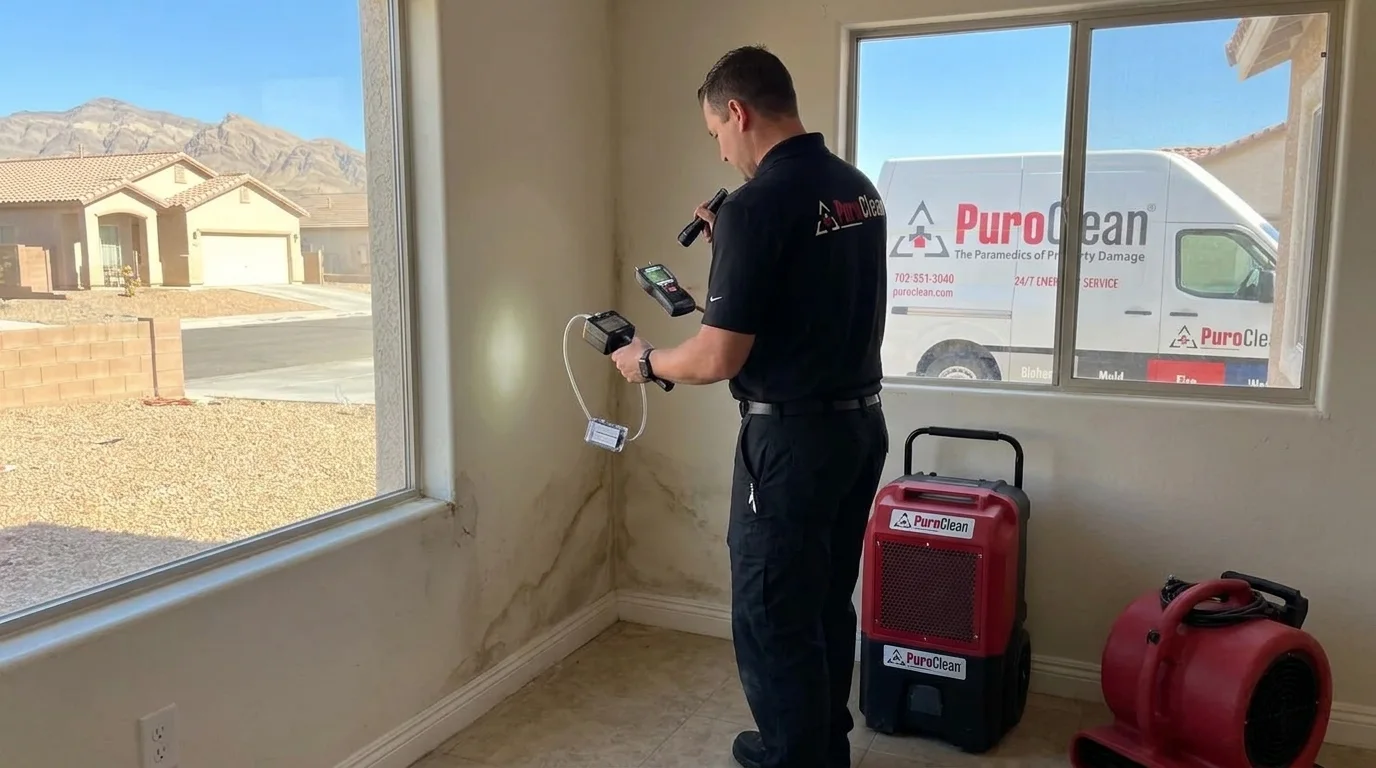
A thorough mold assessment here isn’t a single walkthrough with a flashlight. The process starts with a visual inspection of the areas most vulnerable in Boulder City’s housing stock: attic spaces beneath rooftop cooler units, crawl spaces and slab penetrations where older plumbing runs, and the interior wall framing in pre-1960 construction common near the Historic District.
From there, air sampling captures a baseline of indoor spore concentrations and compares them against an outdoor control sample, a critical step because desert air naturally carries certain mold spores that can skew results if not properly contextualized. Surface swab or tape-lift samples are collected from any visible growth or staining. All samples are sent to an accredited third-party laboratory, and the written report details spore species, concentration levels, and affected areas. That documentation matters whether you’re coordinating with a homeowner’s insurance carrier, satisfying a real estate transaction disclosure, or simply deciding whether remediation is warranted.
Equipment and Methods We Use for Mold Inspection
In Boulder City’s older building stock, standard visual inspection misses a significant share of hidden moisture. Thermal infrared imaging identifies temperature differentials behind plaster and drywall that indicate trapped moisture, without cutting into walls unnecessarily. Calibrated moisture meters confirm whether materials are reading wet below the surface even when they feel dry to the touch, which is common in the thick adobe-style construction found in parts of the Historic District.
For indoor air quality testing, calibrated air pumps draw measured volumes of air through spore-trap cassettes at multiple locations, typically the primary living areas, any rooms with prior water intrusion history, and the HVAC return. This multi-point sampling gives a room-by-room picture rather than a single averaged result, which is especially useful in Boulder City homes where one wing may share a cooler system with another.
Local Note
Homes built in Boulder City’s Historic District during the 1930s and 1940s often used a plaster-over-wood-lath wall system that behaves very differently from modern drywall when moisture intrudes. Plaster is dense and slow to release moisture, so a wall cavity that reads at acceptable surface humidity can still harbor saturated lath and framing behind it. During inspections in this part of Boulder City, particularly in the 89005 ZIP code, we pay close attention to baseboard and window-casing gaps where plaster has cracked over decades, since those cracks are common entry points for moisture and the first places mold establishes a foothold.
If you own or are purchasing a home in this area, don’t let a surface moisture reading give you a false sense of clearance. The inspection process needs to account for what the walls are made of, not just what the meter says at the face.
If you’ve noticed a musty odor, visible discoloration, or recently resolved a water issue in your Boulder City home, the next step is a documented inspection, not a wait-and-see approach. Call PuroClean of East Las Vegas at +17025513040 to schedule a mold inspection and testing appointment in Boulder City, and get a clear picture of what’s actually in your air and walls.
Serving Boulder City from our Las Vegas headquarters — ★ 4.9 · 21 Google reviews
“Lino came out after a leak in my home. I cannot express how wonderful he was. At every step of the way he was knowledgable and reassuring. The process went much more smoothly than I expected. They have an extensive understanding of how to best manage these types of disasters that can happen. I am…” — Johanna, May 2026Read our reviews on Google →
Mold Inspection and Testing in Boulder City: Service Coverage
Frequently Asked Questions
How fast can you arrive for mold inspection and testing in Boulder City?
Are homes in Boulder City's Historic District more likely to have hidden mold problems?
Can a swamp cooler cause mold problems in a Boulder City home?
How does the mold inspection process differ for older Del Prado or Lake Mountain Estates properties versus newer construction?
What does the lab report from mold testing actually tell me?
If I'm buying a home in the 89005 ZIP code, should I get a mold inspection before closing?
Will my homeowners insurance cover mold inspection and testing in Boulder City?
Mold Inspection and Testing response in Boulder City
Most Boulder City calls see a technician on-site within 60 minutes from our Las Vegas headquarters.