
Mold Inspection and Testing in Las Vegas
Mold inspection and testing in Las Vegas and surrounding areas. Insurance billing accepted. Call +17025513040.
You notice a musty smell in the hallway but the walls look fine. Or you’ve had a slow leak under the bathroom vanity for weeks, and now you’re wondering what’s growing behind the cabinet. Mold doesn’t announce itself, it colonizes quietly in wall cavities, under flooring, and inside HVAC ducts, often for months before it’s visible. A mold inspection and testing service answers the question your nose is already asking: is there active mold growth, where exactly is it, and how far has it spread?
What mold inspection and testing actually involves
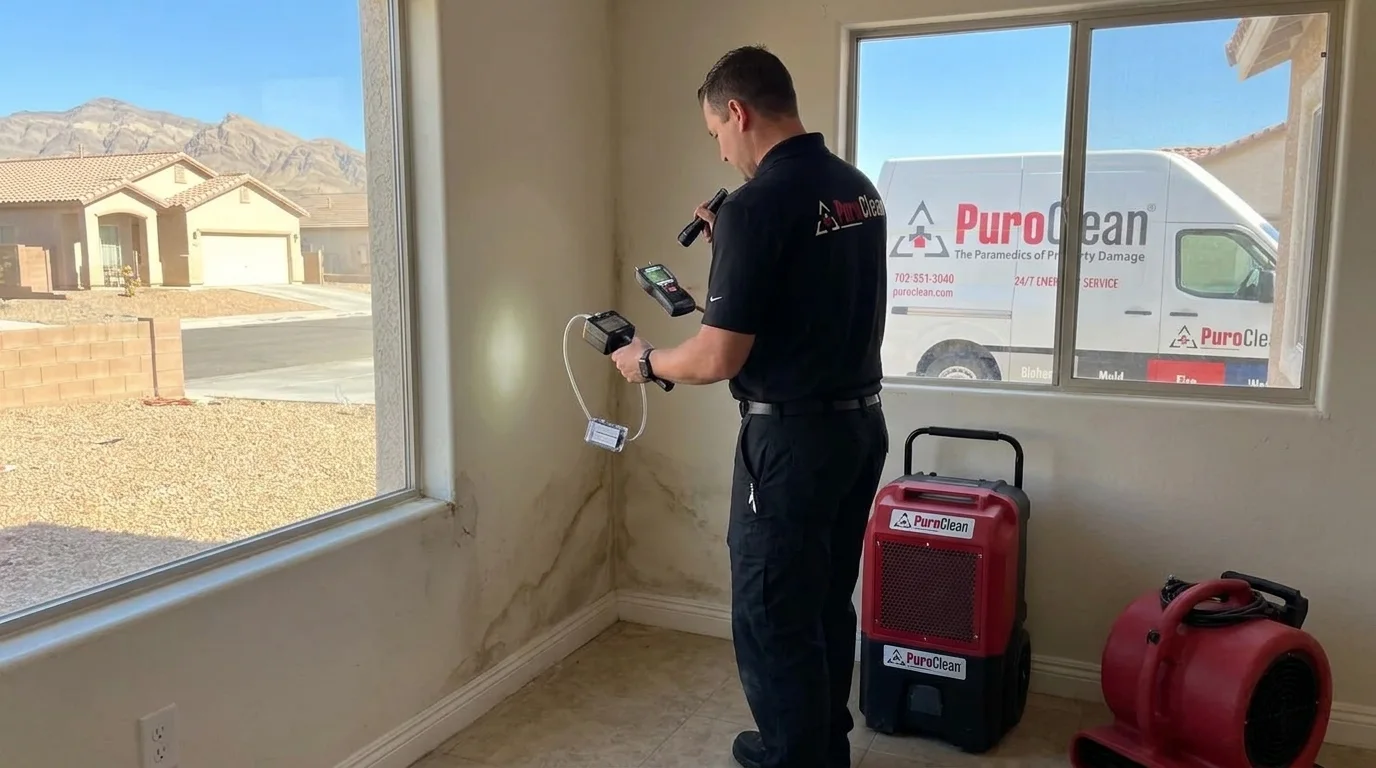
Mold inspection and mold testing are two distinct steps that work together. The inspection is physical, a trained assessor walks the property looking for moisture intrusion points, discoloration, staining, and conditions that support fungal growth: elevated humidity, poor ventilation, past water events, and building materials like drywall and wood framing that hold moisture long after a surface feels dry.
Testing adds laboratory confirmation. Air sampling draws a measured volume of indoor air through a spore trap cassette, which is then analyzed by an accredited third-party laboratory. The lab report identifies the species present and the spore count per cubic meter, compared against an outdoor baseline sample taken the same day. Surface sampling, tape lifts or swabs, can pinpoint whether a stained area is actually mold or just dirt. Bulk sampling removes a small piece of material for culture analysis when a deeper assessment is needed.
In Las Vegas, the desert climate creates a counterintuitive mold risk. Low outdoor humidity means homeowners often run evaporative coolers, which introduce moisture directly into the air stream. Buildings that stay sealed against summer heat can trap that moisture in wall assemblies and attic spaces. Older construction in neighborhoods like Whitney Ranch and the East Side corridor, many homes built in the 1970s and 1980s, frequently used paper-faced drywall and minimal vapor barriers, both of which are hospitable to mold when a plumbing leak or roof intrusion goes undetected.
Our process
-
Pre-inspection interview and moisture mapping. Before any samples are collected, the assessor documents the history of the space: prior water damage, HVAC service records, visible staining, and occupant symptoms. A calibrated moisture meter and thermal imaging camera then map the building envelope, identifying wet zones that don’t show surface damage.
-
Visual assessment and sampling plan. The assessor identifies suspect areas and designs a sampling protocol, how many air samples, where, and whether surface or bulk sampling is warranted. Sampling without a plan wastes money and can miss the actual source.
-
Air and surface sample collection. Air samples run for a set volume using a calibrated pump. Outdoor control samples are collected simultaneously. Surface samples are taken from suspect materials using sterile tape lifts or swabs. Chain of custody documentation accompanies every sample to the laboratory.
-
Third-party laboratory analysis. Samples go to an accredited lab for spore identification and count. Turnaround is typically 24–72 hours for standard analysis. The lab report identifies genera and species, important because some species (like certain Stachybotrys or Chaetomium strains) indicate long-standing moisture problems and carry different remediation implications than common outdoor molds tracked in on shoes.
-
Written assessment report and scope recommendation. The assessor delivers a written report with the lab findings, a diagram of affected areas, and a recommended scope of work if remediation is warranted. This document becomes the foundation for any insurance claim and guides the remediation contractor.
What separates a good mold inspection from a bad one
The most common failure in mold inspection is testing without inspecting, collecting air samples in a room and calling it done. Airborne spore counts can be low even in a heavily colonized building if the colony is behind a sealed wall and not actively disturbed. A thorough inspection uses moisture meters and thermal imaging to find the hidden wet zones that surface sampling alone misses.
A second common problem is the absence of an outdoor control sample. Without a baseline, elevated indoor counts are meaningless, spore species common outdoors in the Mojave (like Cladosporium and Alternaria) will always appear indoors at some level. The comparison between indoor and outdoor samples, not the raw indoor number, is what matters.
Insurance adjusters and industrial hygienists reviewing a claim look for a documented chain of custody for all samples, accredited laboratory results, and a written scope that ties the findings to specific affected areas. A report that lists species without mapping them to locations in the building is difficult to act on and may not satisfy a carrier’s documentation requirements.
What does mold inspection and testing cost?
Typical costs for mold inspection and testing vary based on property size, the number of samples collected, and whether post-remediation clearance testing is included. Most homeowners pay somewhere in the ranges below, these are industry-typical figures, not a quote from PuroClean of East Las Vegas, and every loss is different; PuroClean of East Las Vegas provides a written scope before any work begins.
| Scenario | Typical industry range |
|---|---|
| Single-room visual inspection only | $200 – $400 |
| Whole-home inspection with 2–4 air samples | $400 – $800 |
| Inspection plus surface and bulk sampling | $600 – $1,200 |
| Large property or multi-unit with 6+ samples | $900 – $2,000 |
| Post-remediation clearance testing | $300 – $600 |
| Full inspection, testing, and clearance package | $800 – $2,500 |
Homeowners insurance typically covers mold inspection costs when the mold is a direct result of a covered peril, a burst pipe or storm intrusion, for example, but generally does not cover inspection for mold that developed from long-term humidity or a slow leak that went unreported. Documenting the moisture source is critical to a successful claim.
Seasonal and regional considerations
Las Vegas’s monsoon season, which runs roughly from mid-June through September, brings short, intense rain events that can overwhelm flat roofs, clogged gutters, and poorly graded lots. Water that enters a wall assembly during a monsoon storm and isn’t dried within 24–48 hours creates conditions for mold colonization. The same sealed, air-conditioned interiors that protect against 115-degree summers can slow the evaporation that would otherwise limit growth. If your home experienced any roof or window intrusion during monsoon season, a mold assessment before winter is worth scheduling, mold established in late summer is often not discovered until the following spring.
Service area
PuroClean of East Las Vegas serves the greater Las Vegas Valley, including Henderson, North Las Vegas, Boulder City, Summerlin, and surrounding communities throughout Clark County. City-specific pages for mold inspection in Henderson and North Las Vegas link back to this page for full service details.
If you’ve noticed a persistent musty odor, had a recent water event, or want to know what’s behind a wall before you close on a property, call (702) 551-3040 to request an air quality test. A written assessment, not a verbal estimate, is what you need to make an informed decision and protect your claim.
Services We Handle
- Mold Inspection
- Mold Testing
Frequently Asked Questions
Does homeowners insurance cover mold inspection and testing?
What's the difference between air sampling and surface sampling, and do I need both?
Can mold levels be high even if I can't see any mold growth?
How long does mold start growing after a water event, and why does timing matter for testing?
What does a post-remediation clearance test involve, and who should perform it?
Looking for the best mold inspection and testing company in Las Vegas?
PuroClean of East Las Vegas provides mold inspection and testing in Las Vegas, NV and the surrounding area. Customers rate us 4.9 out of 5 stars across 21 Google reviews. We answer calls 24/7 — call +17025513040 for immediate help.
Need Mold Inspection and Testing now?
We respond 24/7 across Las Vegas and surrounding NV cities.
Related Coverage
- Our Restoration Services
- Contact PuroClean of East Las Vegas
- Mold Inspection and Testing in Boulder City
- Mold Inspection and Testing in Henderson
- Mold Inspection and Testing in North Las Vegas
- Mold Inspection and Testing in Paradise
- Mold Inspection and Testing in Spring Valley
- Mold Inspection and Testing in Sunrise Manor
- Mold Inspection and Testing in Whitney
- How To Test for Mold in Your Home (DIY Kits vs a Pro Inspection)