
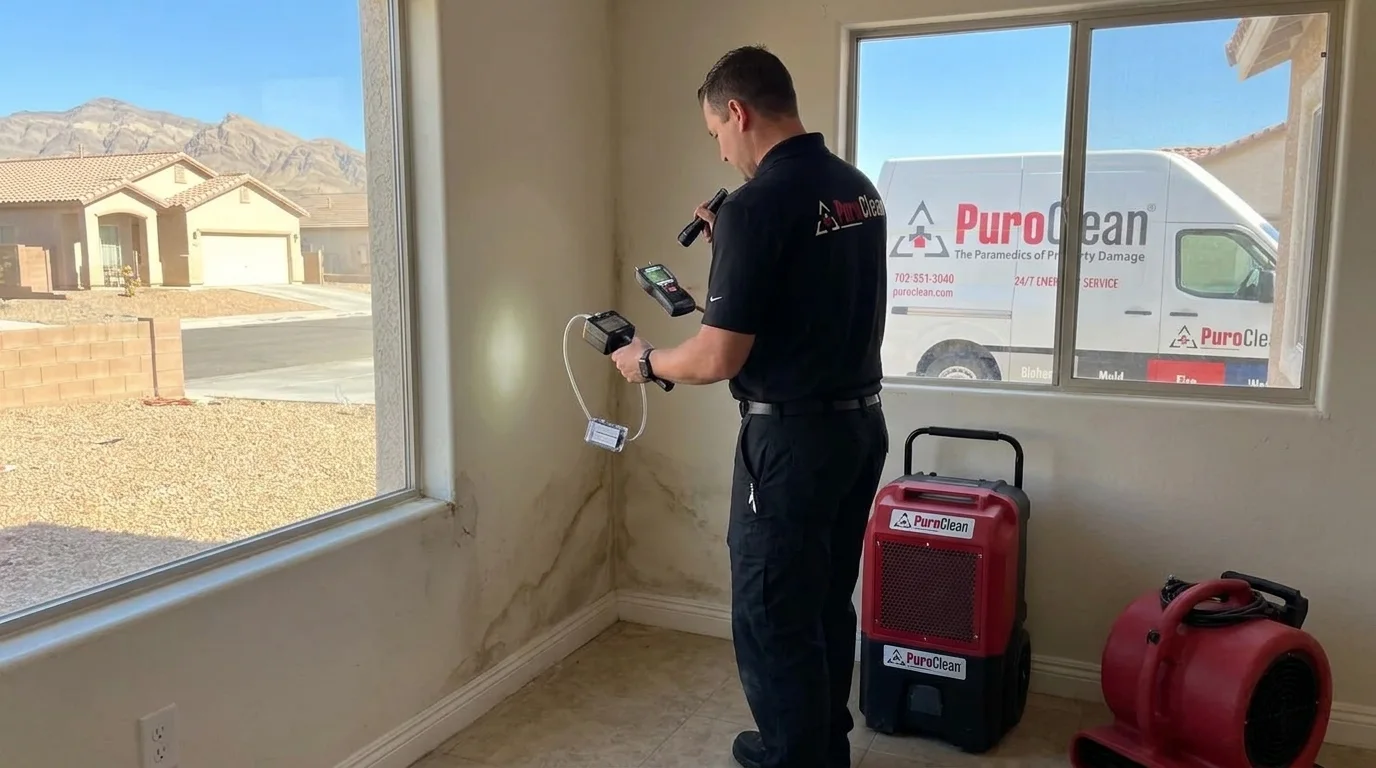
Mold Inspection and Testing in Spring Valley
Mold inspection and testing in Spring Valley, NV. Insurance billing accepted. Call +17025513040.
Our technicians are dispatched from our Las Vegas, NV headquarters and are typically on-site in Spring Valley within 60 minutes of your call.
Summer in Spring Valley is hard on buildings in ways that aren’t always obvious. When outdoor temperatures push past 110°F, the HVAC systems serving dense corridors like Chinatown and the surrounding subdivisions run almost continuously, and that constant cycling creates condensation inside ductwork, wall cavities, and ceiling plenums that never fully dries before the next cooling cycle begins. Mold doesn’t need much: 24 to 48 hours of moisture and an organic surface is enough to start colonizing. If you’ve noticed a musty smell, unexplained allergy symptoms, or discoloration near a vent or baseboard, a professional mold inspection and testing assessment is the right first step before any remediation work begins.
Why Spring Valley Properties See Elevated Mold Risk
Spring Valley sits in a basin where the soil drains quickly in open desert but behaves very differently under a concrete slab or behind stucco cladding. The valley’s low humidity is often cited as protection against mold, and in open air that’s partly true, but interior environments tell a different story. Homes and commercial buildings in ZIP codes like 89117 and 89147 are heavily air-conditioned for eight or more months a year, which means the indoor humidity differential between a cooled interior and a sun-baked exterior wall can be dramatic. When a pipe sweats, a supply line drips behind a cabinet, or a pan drain backs up in a rooftop unit, that moisture has nowhere to go and no natural airflow to carry it away.
The Chinatown corridor specifically sees a pattern of HVAC condensation and pipe-break calls during peak summer months, and many of the commercial suites there share mechanical systems across tenant spaces, meaning a moisture event in one unit can affect wall assemblies in adjacent ones before anyone notices. Residential communities like Rhodes Ranch and Peccole Ranch, built largely in the 1990s and early 2000s, feature stucco-over-frame construction that can trap moisture behind the exterior cladding for extended periods, making surface inspections alone unreliable.
Our Mold Inspection and Testing Process in Spring Valley
A mold inspection is not the same as mold remediation, and the distinction matters. The inspection phase is diagnostic: the goal is to determine whether mold is present, where it is, what species are involved, and at what concentration, before any disturbing or cleaning work begins. Skipping straight to remediation without testing means you may not know whether the work actually resolved the problem.
The process typically begins with a visual assessment of the areas of concern, walls, ceilings, crawl spaces, mechanical rooms, and any area with a documented or suspected moisture history. Where visual evidence is inconclusive, non-invasive moisture meters and thermal imaging can reveal wet building materials that look dry at the surface. Mold can read clean on a wall that has saturated framing behind it.
Air sampling and surface sampling collect spore data that gets sent to an accredited third-party laboratory. The lab results identify the genus and concentration of mold spores in the indoor air compared to an outdoor baseline sample, a comparison that’s essential for interpreting results accurately, because some spore types are naturally present in desert air at elevated counts. Indoor air quality testing in a Spring Valley home needs to account for that baseline before drawing conclusions.
Equipment and Methods We Use for Mold Inspection
Air-O-Cell cassette sampling and bulk or tape-lift surface sampling are the standard collection methods for most residential inspections. In larger commercial spaces, particularly the mixed-use buildings common near Spring Valley’s retail corridors, we may use spore trap sampling at multiple locations to map how spore concentrations vary across a floor plate, which helps identify the likely moisture source even when it isn’t visually obvious.
Thermal imaging cameras are particularly useful in Spring Valley’s stucco construction. Stucco is a reservoir cladding, it absorbs and holds water, and thermal differentials between a wet section and a dry section of wall are often detectable even when the surface temperature is the same. Moisture meters calibrated for both wood and masonry substrates give us a reading at depth, not just at the face of the material.
All samples are handled per chain-of-custody protocols and submitted to an independent, accredited laboratory. The written report you receive documents findings, sample locations, lab results, and recommended next steps, a format that holds up for insurance claims, HOA review boards, and real estate transactions alike.
Local Note
In the stucco-frame homes that make up much of Rhodes Ranch and Peccole Ranch, the weep screed at the base of the exterior wall is designed to drain any water that gets behind the cladding, but in practice, those screeds get painted over, blocked by landscaping, or installed too close to grade. When that drainage path is compromised, moisture accumulates at the base of the wall assembly and can wick up into the framing before it ever shows on the interior drywall. If you’re having an inspection done on a home in these communities and the concern is near an exterior wall, it’s worth asking the inspector to check the weep screed condition and the grade slope at the foundation, that context often changes where the sampling locations should be.
If you’re in Spring Valley and you’re not sure whether what you’re seeing warrants a full inspection, the right call is to get a professional assessment before conditions progress. Contact PuroClean of East Las Vegas at +17025513040 to schedule mold inspection and testing for your Spring Valley property.
Serving Spring Valley from our Las Vegas headquarters — ★ 4.9 · 21 Google reviews
“PuroClean do a great job cleaning our bathroom floor and carpet in the bedroom.” — Gina, September 2026Read our reviews on Google →
Mold Inspection and Testing in Spring Valley: Service Coverage
Frequently Asked Questions
How fast can you arrive for mold inspection and testing in Spring Valley?
Are homes in Rhodes Ranch or Peccole Ranch more prone to hidden mold than newer construction elsewhere in the valley?
How does Spring Valley's HVAC-heavy climate affect indoor air quality testing results?
I'm in the 89147 ZIP code and my HOA requires documentation before I can hire a remediation contractor. Does a mold inspection report satisfy that?
What's the difference between mold inspection and mold testing, and do I need both?
Can mold inspection results be used for an insurance claim on a Spring Valley property?
Mold Inspection and Testing response in Spring Valley
Most Spring Valley calls see a technician on-site within 60 minutes from our Las Vegas headquarters.