
Water Cleanup in Las Vegas
Water cleanup in Las Vegas and surrounding areas. Insurance billing accepted. Call +17025513040.
Standing water doesn’t wait. Within the first hour, it migrates through drywall seams, wicks into insulation, and begins saturating the subfloor beneath flooring that still looks dry on top. By 24 to 48 hours, the conditions for mold colonization are in place. Water cleanup isn’t just removing what you can see — it’s tracing moisture to where it has traveled, extracting it completely, and drying structural materials to their pre-loss moisture content before secondary damage sets in.
What water cleanup actually involves
The visible puddle is rarely the whole problem. Water from a burst pipe, failed appliance, or roof intrusion follows the path of least resistance — down wall cavities, under hardwood flooring, through concrete block, into crawl spaces. A thorough water cleanup response starts with thermal imaging and moisture mapping to find all of it, not just the obvious wet areas.
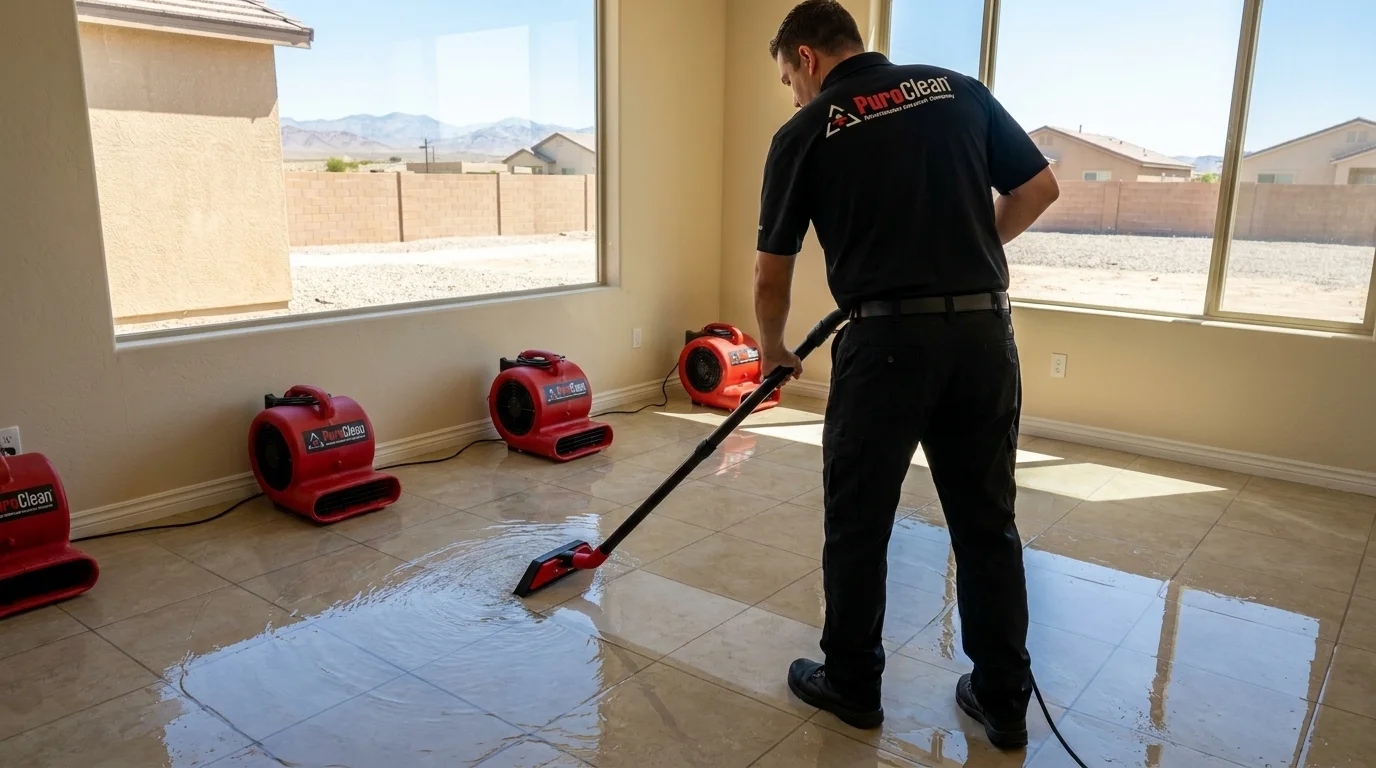
Once the scope is clear, truck-mounted or portable extractors pull standing water from carpet, padding, and hard flooring. High-capacity air movers and industrial dehumidifiers then take over, creating a controlled drying environment that pulls moisture out of structural materials — not just the air. Drying logs are recorded daily so there’s a documented record of how materials responded, which matters both for your insurance claim and for confirming the structure is genuinely dry before any repairs begin.
Timeline varies by category of water and materials affected. Clean water losses in a single room with no structural penetration can dry in three to five days. Losses involving saturated drywall, hardwood floors, or Category 2 or 3 water (gray or black water from sewage or flooding) take longer and require additional steps — containment, antimicrobial treatment, and in some cases controlled demolition to remove materials that cannot be dried in place.
Our process
-
Moisture mapping and loss assessment. Before any equipment is placed, technicians use moisture meters and thermal imaging to document where water has traveled. This establishes the drying goal — the target moisture content for each affected material — and identifies any Category 2 or 3 contamination that changes the protocol.
-
Standing water extraction. Truck-mounted extractors remove bulk water from floors, carpet, and low-lying areas. Submersible pumps handle deeper standing water in basements or utility rooms. Speed here matters: the faster bulk water is out, the less time it has to penetrate deeper into structural assemblies.
-
Controlled structural drying. Air movers are positioned to create directed airflow across wet surfaces; dehumidifiers pull the evaporated moisture out of the air before it can re-deposit elsewhere. Equipment placement follows drying science, not guesswork — the number of air movers and dehumidifiers is calculated based on the volume of wet materials and the ambient conditions in the space.
-
Daily moisture monitoring. Technicians return each day to read moisture levels at documented points and adjust equipment as materials dry. This isn’t optional — it’s how you confirm drying is progressing and catch areas that are holding moisture longer than expected. Readings are logged and become part of the claim file.
-
Antimicrobial treatment and clearance. Once materials reach their drying goals, affected surfaces receive antimicrobial treatment. For Category 2 or 3 losses, any materials that absorbed contaminated water and cannot be decontaminated — drywall below the flood line, carpet and pad — are removed and documented before the space is cleared.
What separates a good water cleanup response from a bad one
The most common failure in water damage cleanup is calling a job dry before it is. Surface readings can show acceptable moisture while the framing behind the drywall or the subfloor beneath the flooring is still saturated. A technician who reads only the surface and pulls equipment early leaves hidden moisture that will feed mold growth inside the wall cavity — often not discovered until months later when a musty smell appears or drywall begins to bubble.
A second common problem is ignoring Category classification. Water from a toilet overflow, sump pump failure, or any source that has contacted soil is not clean water. Treating it like a clean-water loss — extracting and drying without containment or antimicrobial protocol — spreads contamination rather than removing it. Insurance adjusters reviewing a claim file look for documentation that the water category was identified and that the response matched it.
Good operators also document everything: pre-drying moisture readings, daily logs, equipment placement diagrams, and post-drying clearance readings. That paper trail protects the homeowner if a dispute arises with the carrier and demonstrates that drying was completed to a measurable standard, not just to the technician’s judgment.
What does water cleanup cost?
Typical costs for water damage cleanup depend heavily on the size of the affected area, the category of water involved, and how far moisture has migrated into structural materials. Most homeowners pay somewhere in the ranges below — these are industry-typical figures, not quotes from PuroClean of East Las Vegas.
| Scenario | Typical range |
|---|---|
| Single room, clean water (Category 1) | $1,200 – $3,500 |
| Multi-room, clean water with subfloor involvement | $3,500 – $7,000 |
| Category 2 (gray water), partial demolition needed | $4,000 – $10,000 |
| Category 3 (black water / sewage), full protocol | $7,000 – $20,000+ |
| Basement flooding, standing water removal + drying | $3,000 – $12,000 |
| Crawl space water intrusion | $2,500 – $8,000 |
Every loss is different, and PuroClean of East Las Vegas provides a written scope of work before any work begins so there are no surprises. Standard homeowners insurance typically covers sudden and accidental water damage — a burst pipe, appliance failure, or roof leak — but generally excludes gradual leaks and ground-level flooding, which requires a separate flood policy.
Seasonal and regional considerations
Las Vegas sits in the Mojave Desert, but water damage is a year-round reality here — and the desert climate creates conditions that aren’t always obvious. The valley’s monsoon season, running roughly July through September, brings intense short-duration storms that can overwhelm flat or low-slope roofs and push water through window frames and door thresholds that haven’t been tested by rain in months. Pooling in yards and along block walls can find its way into slab foundations through cracks that dry weather keeps sealed.
The dry climate also creates a false sense of security after a loss. Because ambient humidity in Las Vegas is often low, surfaces can feel and read dry faster than the structural materials behind them actually are. That low outdoor humidity is useful for drying — but it doesn’t eliminate the need for moisture monitoring inside wall cavities and below flooring, where conditions are more isolated from the ambient air.
Older neighborhoods in East Las Vegas — many built in the 1960s through 1980s — frequently have original copper or galvanized plumbing that is reaching the end of its service life, and slab foundations that make leak detection more involved when a pipe fails beneath the concrete.
Service area
PuroClean of East Las Vegas serves the greater Las Vegas Valley, including Henderson, North Las Vegas, Summerlin, Boulder City, and surrounding communities. The city-specific pages for each area link back here for the full detail on what water cleanup involves — the process is the same regardless of zip code.
Frequently Asked Questions
Does homeowners insurance cover water cleanup?
How long does structural drying typically take after water damage?
What is the difference between Category 1, 2, and 3 water, and why does it matter for cleanup?
My floors feel dry — do I still need professional water cleanup?
What should I do — and not do — while waiting for water cleanup to begin?
Looking for the best water cleanup company in Las Vegas?
PuroClean of East Las Vegas provides water cleanup in Las Vegas, NV and the surrounding area. Customers rate us 4.8 out of 5 stars across 18 Google reviews. We answer calls 24/7 — call +17025513040 for immediate help.
Need Water Cleanup now?
We respond 24/7 across Las Vegas and surrounding NV cities.